

MoneyWika earns a commission if you buy through some links on this page, at no extra cost to you. How we make money
AI didn't break hiring. It moved the bottleneck.
Finding and screening talent anywhere on earth is now the easy part of building a team. The hard part is the paperwork that makes the hire legal, and that is where the real infrastructure war is being fought.
A founder I spoke with last spring hired a senior data engineer in Lisbon in nine days. She wrote the job post with an AI assistant, let an automated sourcing tool surface fifty candidates from a pool she would never have found on her own, ran first-round screening through a scheduling bot, and made the offer after two video calls. Nine days from "we should hire someone" to "welcome aboard." Then the offer sat, unsigned, for six more weeks.
Not because the candidate hesitated. Because nobody could work out how to legally pay him.
Solving that unglamorous problem, not the AI wizardry, is the actual business of global-employment platforms like Deel. Hold that thought, because it turns out to be the whole point.
That gap, between how fast AI now lets us find people and how slowly we can actually employ them across a border, is the most important and least discussed story in hiring right now. Everyone is arguing about whether a machine should read your resume. Almost nobody is talking about what happens after it says yes.
So let's talk about the part that actually matters in 2026.
The resume was never really the problem
For thirty years the constraint on hiring was screening. You would post a role, drown in applications, and spend the expensive middle weeks of the process reading paper. By one widely cited estimate from the resume-analytics firm Jobscan, 99% of Fortune 500 companies already run applicants through some form of tracking or filtering software. That number did not appear in 2023. Automated screening is old news.
What generative AI changed is the ceiling. Sourcing tools now write outreach, rank candidates against a role in seconds, draft interview questions, summarize transcripts, and schedule the whole thing without a coordinator touching a calendar. The work that used to eat a recruiter's week happens over a coffee break.
I want to be honest about the limits of this, because the hype gets tiresome. AI is very good at the top of the funnel and genuinely bad at the bottom. It surfaces and sorts. It does not judge whether someone will thrive on your specific team, and every serious talent leader I know still treats a model's ranking as a suggestion, not a verdict. The Stanford HAI figure above hints at the darker edge of the same trend: when screening gets cheap, the first rung of the career ladder is the first thing to disappear, and young workers are absorbing that cost first.
But set the failure modes aside for a second, because they are not the structural shift. The structural shift is quieter and much bigger.
When the cost of finding a qualified person anywhere on earth falls to near zero, the map stops mattering. The law does not.
AI made sourcing global. Employment stayed stubbornly local.
Here is the thing the productivity demos skip. A model does not care whether your candidate lives in Ohio or Osaka. It will rank them the same way and draft the same offer letter. For the first time, the practical friction of considering someone on another continent has basically vanished from the front of the process.
The back of the process did not get the memo.
The moment you actually hire that person in Lisbon, you inherit Portuguese employment law, Portuguese payroll tax, mandatory benefits, holiday accrual rules, a currency you do not hold, and a termination process that looks nothing like an American one. Get the classification wrong, call them a contractor when the law says employee, and the penalties are not theoretical. This is precisely the mess my nine-day founder ran into, and it is the subject we dug into separately in our breakdown of employee versus contractor classification, because it is where most first-time global hires quietly go wrong.
So the bottleneck moved. It used to sit in selection, and AI dissolved it. Now it sits in compliance, and no amount of clever prompting makes a foreign tax authority go away. You cannot automate your way out of needing a legal entity in a country. Or rather, you can, but only if someone else has already built that entity and will rent it to you. Which brings us to the layer of this stack nobody puts on a pitch deck.
What the demo shows you, and what it leaves out
Picture a 30-person software company in Toronto that needs a designer. In 2021 they would have hunted within commuting distance. In 2026 their sourcing tool hands them a shortlist in an afternoon, and the strongest candidate happens to live in Kraków.
The front half is a highlight reel. AI drafts the outreach, screens the portfolio, books the calls, even summarizes the interviews so the panel can compare notes. Two weeks, start to shortlist to offer. This is the part that gets screenshotted.
Then reality. To employ her properly, the Toronto company needs a legal presence in Poland, or a partner who has one. They need to run Polish payroll, withhold the right tax, provide statutory benefits, and issue a compliant contract in a language their HR lead does not read. Doing that from scratch takes months and a local lawyer. Renting it takes an afternoon. The entire modern global-hiring industry exists in the space between those two sentences.
Where Deel actually fits, and why it matters more now
Deel is usually described as a global payroll company, which is accurate and undersells it. What it really operates is the compliance layer underneath everyone else's hiring. When a company wants to employ that designer in Kraków without opening a Polish subsidiary, Deel acts as the Employer of Record: it already owns the local entity, so it becomes the legal employer on paper while she works for the Toronto team in practice. The contract, the tax withholding, the statutory benefits, the currency, all of it runs on infrastructure that already exists.
The scale is the part that surprised me when I looked into it properly. According to Deel's own disclosures around its October 2025 Series E, the platform processes roughly $22 billion in payroll a year, serves 35,000-plus companies and about 1.5 million workers across 150-plus countries, and keeps more than two thousand in-country legal and payroll specialists on staff to keep all of that compliant. By the first half of 2026 the company said it had crossed $1.5 billion in annual recurring revenue. Whatever you think of the category, that is not a plugin. That is plumbing.
And it is why the AI story and the Deel story are the same story. Every gain AI hands you at the top of the funnel, faster sourcing, wider reach, borderless shortlists, is only bankable if the bottom of the funnel can keep up. A recruiter who can suddenly consider candidates in forty countries creates forty compliance problems the instant someone says yes. The infrastructure layer is what turns that from a legal liability back into a hire. We went deep on how the platform handles this in our full Deel review, if you want the granular version.
AI is the accelerator on your hiring. Compliance infrastructure is the brakes and the steering. A faster car with no brakes is not faster in any way that helps you, it just crashes sooner and in more countries. The teams winning at global hiring in 2026 are not the ones with the flashiest AI sourcing. They are the ones who paired it with an employment layer that can absorb the speed.
Where AI-driven hiring still goes wrong in 2026
If this piece only sold you the upside it would be doing the same thing the vendor demos do. The truth is that pushing AI deeper into hiring has created real, live risk, and regulators have noticed.
AI for recruiting is treated as "high-risk." Bias testing, human oversight, disclosure. Fines up to €35M or 7% of global turnover.
Local Law 144 requires independent bias audits and candidate notice for automated hiring tools.
Employers must disclose and get consent before AI analyzes a candidate's video interview.
The bias problem is the obvious one. A model trained on who a company hired before will happily reproduce who a company hired before, including the parts you are legally not allowed to repeat. This is not a hypothetical concern anymore, it is written into law. New York City's Local Law 144 has required independent bias audits of automated employment decision tools since mid-2023, and Illinois has regulated AI analysis of video interviews since 2020. If your AI ranks or scores candidates, in some jurisdictions you now owe them an audit and a disclosure.
Europe went furthest. The EU AI Act, in force since August 2024, classifies AI used for recruitment, CV filtering, candidate ranking and interview scoring as "high-risk," which triggers obligations around bias testing, human oversight, transparency and record-keeping, with penalties running up to 35 million euros or 7% of global turnover. Crucially for anyone reading this outside Europe, the rules reach any company using AI to hire people into the EU, not just European employers.
Now, the honest wrinkle, and the reason I am wary of any article that states the deadline with false confidence: that timeline is genuinely unsettled as I write this. The heaviest high-risk obligations were pinned to August 2026, but the Commission's "Digital Omnibus" package, floated in late 2025, has been winding its way through trilogue negotiations that would push the employment-AI deadline into late 2027. If someone tells you they know exactly when the hammer falls, they are guessing. What is not in doubt is the direction: AI in hiring is being regulated as a serious matter, and the compliance burden is going up, not down.
Which, you will notice, only sharpens the point of this whole piece. The harder the law leans on how you hire, the more the boring infrastructure layer, the entity, the audit trail, the compliant contract, stops being back-office trivia and starts being the thing that determines whether you can hire at all.
What a modern global-hiring stack looks like
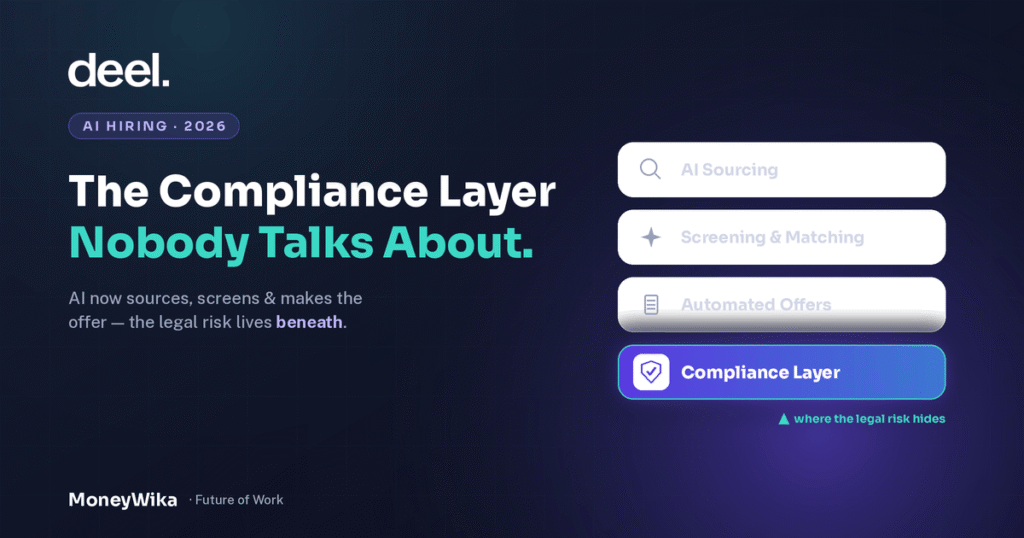
Strip away the branding and a 2026 hiring workflow has four honest layers. The top three are where AI is doing loud, visible work. The fourth is where the hire becomes real, and it is the one that fails silently if you ignore it.
You can assemble the top three layers from a dozen tools and swap them out as the AI market churns, which it will. The bottom layer is different. Once payroll for real people in real countries runs through a provider, you do not casually rip it out, which is exactly why the infrastructure players are racing to own it now. If you are weighing who sits at that base layer, our head-to-head on Deel versus Rippling walks through how the two biggest contenders actually differ in practice.
Pick your AI tools for this year. Pick your employment infrastructure for the next five.
See how Deel enables global hiring
Hire, onboard, and pay employees or contractors in 150-plus countries without opening a single foreign entity. Deel handles the contracts, classification, local tax, and compliance so the offer you made in nine days does not sit unsigned for six weeks.
Explore Deel for global hiring →Employer of Record · global payroll · contractor management · runs in 150+ countries
Questions people actually ask
No, and the framing misses what is happening. AI is replacing the repetitive middle of recruiting, the sourcing, the first-pass screening, the scheduling, the note-taking, not the judgment at either end.
What it changes is the shape of the job. Recruiters spend less time on manual sorting and more on candidate relationships, hiring strategy, and the messy human calls a model cannot make. The roles most exposed are pure coordination roles, not the recruiters who own the outcome.
The Act treats AI used for recruitment, CV filtering, candidate ranking, and interview scoring as "high-risk." In practice that means obligations around bias testing, human oversight, transparency, and record-keeping, with fines that can reach 35 million euros or 7% of global turnover.
It also reaches beyond Europe: if you use AI to hire people into the EU, you are in scope even if your company is not European. The exact deadline for the heaviest obligations is in flux, originally August 2026, with a proposed deferral toward late 2027 still under negotiation as of mid-2026, so confirm the current status before you rely on any date.
Mostly in four places: writing and targeting job posts, surfacing and ranking candidates, automating scheduling and communication, and summarizing interviews. Applicant tracking systems have done basic filtering for years; generative AI added drafting, ranking, and conversation on top.
The consistent pattern among teams doing it well is that AI accelerates the funnel but does not close it. A person still makes the hiring decision, both because models are unreliable judges of fit and because, in a growing number of places, the law requires a human in the loop.
Deel sits at the bottom of the stack, after the decision is made. Once you have chosen someone, Deel handles employing and paying them compliantly, especially across borders, acting as Employer of Record so you do not need your own legal entity in their country.
That is why it pairs naturally with AI sourcing tools. AI widens your reach to candidates in many countries; Deel is what turns a cross-border "yes" into a legal, paid hire. Our full Deel review covers how the platform handles contracts, payroll, and benefits in detail.
Yes, and it is the most common way small and mid-sized teams do it. An Employer of Record already owns a legal entity in the country, becomes the formal employer for compliance purposes, and lets you direct the person's day-to-day work without setting up your own subsidiary.
The alternative, classifying them as a contractor, is simpler but carries real misclassification risk if the working relationship actually looks like employment. We break down that specific trade-off in our guide to employee versus contractor classification.
📋 How we researched this
This explainer is built on primary data from the World Economic Forum's January 2025 Future of Jobs Report, the Stanford HAI 2026 AI Index, Deel's own October 2025 Series E disclosures and 2026 company announcements, and current regulatory texts covering the EU AI Act, New York City Local Law 144, and the Illinois AI Video Interview Act. Figures were current at the time of writing in August 2026; regulatory timelines in particular are moving, so verify the latest status before acting on any date.
Sources
- World Economic Forum, Future of Jobs Report 2025 (published January 2025): 170M jobs created, 92M displaced, net +78M by 2030; 86% of employers expect AI to transform their business.
- Stanford Institute for Human-Centered AI (HAI), 2026 AI Index: employment for U.S. developers aged 22 to 25 down roughly 20% since 2024.
- Deel, Series E announcement (October 2025): ~$22B payroll processed annually, 35,000+ customers, 1.5M+ workers, 150+ countries; $1B+ ARR; $17.3B valuation. 2026 company updates: $1.5B+ ARR (H1 2026).
- EU AI Act (Regulation 2024/1689), Annex III high-risk classification for employment and recruitment AI; Digital Omnibus deferral proposal (2025 to 2026).
- NYC Local Law 144 (automated employment decision tools, effective 2023); Illinois Artificial Intelligence Video Interview Act (effective 2020).
- Jobscan, applicant tracking system adoption among Fortune 500 companies.
More in Hiring, Payroll & Remote Teams