
ActiveCampaign shipped Active Intelligence 3.0: Wavelength on August 26, 2026, its first named AI release. This review has been updated throughout: a new section on what changed, the 12 new capabilities, renamed features, refreshed ratings, and an updated verdict. For a full walkthrough of the release, see our Active Intelligence 3.0: Wavelength guide.
What Is ActiveCampaign?
ActiveCampaign is a cloud-based marketing automation platform built to help businesses manage the entire customer journey from a single place, email marketing, a built-in CRM, SMS and WhatsApp messaging, landing pages, forms, and the automation logic that ties them all together. If you've ever read a "best email marketing software" roundup, you've seen its name near the top. It sits in a deliberate middle ground: more powerful than a simple newsletter tool like Mailchimp, but more accessible and affordable than enterprise suites like Salesforce or HubSpot's higher tiers.
What it's known for, more than anything, is its automation builder. This is the visual canvas where you create multi-step workflows, branching logic, conditional waits, and triggers based on almost any customer behavior, from opening an email to abandoning a cart to moving through a sales pipeline stage. For a long time, that flexible automation engine was the whole reason serious marketers chose ActiveCampaign over cheaper alternatives.
But the version of ActiveCampaign you'd sign up for today is meaningfully different from the one that built that reputation. In 2025, the company launched Active Intelligence, an AI layer that has since reshaped how the entire platform works. Then in August 2026 it shipped Active Intelligence 3.0: Wavelength, the first release of that AI layer with a name of its own, and the biggest change yet to how it behaves: instead of waiting for a prompt, it brings drafts, recaps and automation warnings to you. That's the real story of this review, so let's get into it properly.
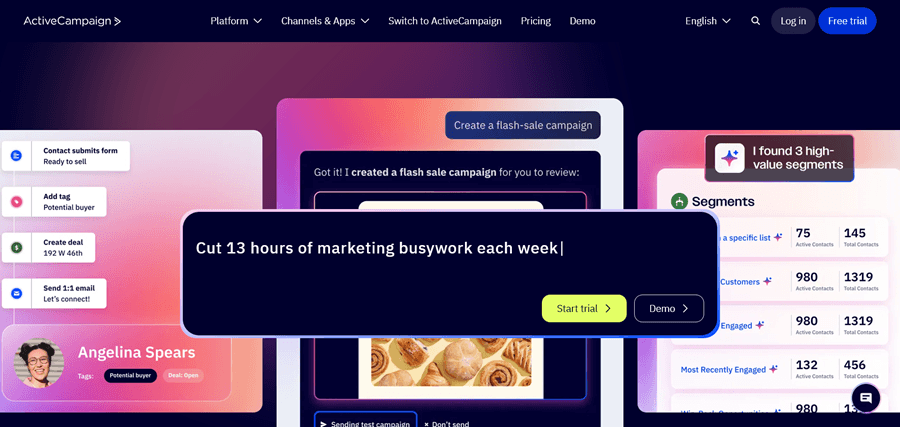
ActiveCampaign is an all-in-one marketing automation and CRM platform whose AI, now on Active Intelligence 3.0: Wavelength, doesn't just execute your campaigns. It learns your account, watches your automations, and brings recommendations and drafts forward before you ask.
ActiveCampaign at a Glance
Before the deep dive, here's the essential context. ActiveCampaign was founded in 2003 by Jason VandeBoom, who still runs the company as CEO today. It began as on-premise email software out of Chicago and transitioned fully to a SaaS model in the early 2010s, growing into one of the most widely used marketing platforms for small and mid-sized businesses. It holds a 4.5/5 rating on G2 from over 14,500 reviews, and in its own surveyed data 89% of customers say it meets their needs better than the alternatives they considered.
Founded: 2003 · Founder/CEO: Jason VandeBoom · HQ: Chicago, IL · Category: Marketing automation, CRM, autonomous marketing · Best for: Small to mid-sized businesses, ecommerce, and agencies · Free trial: 14 days, no credit card needed
The Shift to Autonomous Marketing
"Autonomous marketing" is the term ActiveCampaign now uses to describe its product, and it's worth defining precisely because the phrase gets thrown around loosely. Autonomous marketing is an AI-driven approach where intelligent agents help manage strategy, content creation, execution, and optimization, without requiring you to manually set up every single step.
The distinction from traditional automation is the whole point. Old-school automation is rigid and static: "When someone abandons their cart, wait exactly two hours, then send email #3." You do all the thinking; the platform just executes the instructions you gave it. ActiveCampaign's pitch with Active Intelligence flips that, you set the goal, and the AI analyzes performance, identifies opportunities, and proposes or builds the campaigns and automations to reach it.
The company has leaned hard into this. Through 2025 Active Intelligence grew into a set of AI tools woven across the platform, from campaign and automation builders to Brand Kit, memory and custom instructions in the 2.8 release. Active Intelligence 3.0: Wavelength builds on that foundation with 12 capabilities organised into three pillars, External Intelligence, Autonomous Actions and Advanced AI, all running on one shared context layer drawn from your account history, automations, performance and brand.
Here's why that matters. Most AI marketing tools are reactive: you ask a question or write a prompt, and the AI answers. ActiveCampaign's pitch is the opposite. With Active Intelligence 3.0: Wavelength, the AI prepares campaign drafts, runs scheduled recaps, monitors automation health and brings in outside signals like competitor and industry news, so the next move is waiting for you rather than the other way round. In November 2025 ActiveCampaign also became the first autonomous marketing platform to integrate Anthropic's Claude, which now underpins much of how its agents reason about your data.
"Earlier releases made the AI's answers better. Active Intelligence 3.0: Wavelength changes who asks the question first."
It's worth being upfront that ActiveCampaign isn't alone in chasing this AI-driven positioning. HubSpot, Klaviyo, and Mailchimp are all moving the same direction, and if you're weighing it specifically against the most common alternative, our detailed ActiveCampaign vs Mailchimp comparison breaks down the head-to-head feature by feature. For this review, I'm focused on evaluating ActiveCampaign on its own merits: what it does, what it costs, and whether the "autonomous" label holds up.
New in 2026: Active Intelligence 3.0: Wavelength
Active Intelligence 3.0: Wavelength launched on August 26, 2026, and it is the most significant change to ActiveCampaign's AI since Active Intelligence first arrived. The earlier 2.8 release improved what you got after asking: memory across sessions, Brand Kit voice and tone, custom instructions, document uploads, and connectors to Google Ads, Wix, Calendly and Stripe. The 3.0 release changes when the AI shows up.
ActiveCampaign sums it up in three beats. It knows your account deeply, it acts proactively through drafts, monitoring and recommendations, and it helps you engage your audience more effectively as a result. Every recommendation is built from your own account, your history, your patterns and your results, not a one-size-fits-all playbook.
AI Prompt Block is now the AI Actions Library, a rename plus an update. AI Activities is being retired, with usage moving into the Premium AI credits framework (that migration is still in progress). Active Intelligence 2.8 hasn't been switched off; it's now the baseline experience accounts fall back to.
In practice, the capability I'd switch on first is Automation Health monitoring. Automations fail quietly, a renamed form field or a tag that stops being applied, and having the platform flag it means a broken welcome series gets fixed while it still matters. Scheduled recaps are a close second: a weekly performance summary that arrives without anyone asking builds a steady record of what's landing with your audience.
ActiveCampaign lists Active Intelligence 3.0: Wavelength for Starter, Plus, Pro and Enterprise plan types, but capabilities are reaching accounts in stages and availability can vary by account and capability. Drafts are prepared for you to review and approve, so keep applying your usual brand and strategy standards. Our full Active Intelligence 3.0: Wavelength guide covers every capability and a first-week setup plan.
Traditional Automation vs. Autonomous Marketing
To make the difference concrete, here's the practical contrast between the automation most marketers have used for years and what ActiveCampaign now ships across its plans. Toggle between the two.
Core Features & Tools
Strip away the AI for a moment, and ActiveCampaign is still a deep, capable platform. Here's a breakdown of the core modules you'll actually work in, these are the foundations that the Active Intelligence layer sits on top of.
This is not a five-minute-to-master tool. Most new users report needing three or four sessions before navigating it comfortably. The pre-built recipe library shortcuts the basics, a welcome series or abandoned cart flow can be live within hours, but genuinely complex, branching workflows take a focused afternoon or two to build properly the first time.
What the AI Actually Does (Active Intelligence)
Active Intelligence isn't a single chatbot bolted onto the side, it's a set of AI tools woven through the whole platform. These are the everyday builders you'll use most; Active Intelligence 3.0: Wavelength, covered above, adds the proactive layer on top of them.
There's a real-world reason this proactive model matters, and it's the part of ActiveCampaign I find most genuinely useful rather than just impressive on a slide. The hardest part of running marketing isn't coming up with ideas, it's attention. A campaign can underperform quietly for a week before anyone notices, and the more campaigns you run, the more those quiet dips slip past you. AI that flags the dip as it happens, and hands you a ready-made fix, means problems get solved while they still affect results, which is exactly what the monitoring and recaps in Active Intelligence 3.0: Wavelength are built for.
Active Intelligence doesn't replace the marketer. You still own strategy, offers, and brand decisions. What changes is that the AI now brings the next move to you, drafts, recaps and automation warnings grounded in your own account, so more of your campaigns get the attention they need to land with your audience.
Real Customer Results
Claims are easy; documented outcomes are harder to fake. Here are three named ActiveCampaign customers whose results have been publicly attributed, useful for seeing whether autonomous marketing produces real numbers and not just a nicer dashboard.
Beyond individual stories, ActiveCampaign's own surveyed data claims 88% of customers see value faster than with competitors, a 17% increase in click-through rates from Predictive Sending, and 83% ROI within the first year. These figures predate Active Intelligence 3.0: Wavelength, and ActiveCampaign hasn't yet published verified performance numbers for the new release. I'd treat any vendor's self-reported aggregate stats with healthy skepticism, but the specific, named case studies above are concrete and attributable, which already puts them ahead of most "AI marketing" claims floating around right now.
Pricing, What You'll Actually Pay
ActiveCampaign uses contact-based, tiered pricing across four plans. Below is the most common reference point, pricing for 1,000 contacts, billed annually (monthly billing runs roughly 25–30% higher). There's no permanent free plan, but every tier has a 14-day free trial with no credit card required.
- Email marketing & basic automation
- 900+ integrations, API access
- Site tracking & inline forms
- 10x contact email send limit
- Unlimited automation actions
- Landing pages + AI content generation
- Built-in Sales CRM & lead scoring
- SMS & Shopify/WooCommerce integration
- Predictive sending & attribution
- Conditional content, A/B testing
- Advanced segmentation & reporting
- 12x contact email send limit
- SSO & custom mailserver domain
- Dedicated account team
- Custom reporting & onboarding
- 15x contact email send limit
The headline prices cover the base plan only. Enhanced CRM (Pipelines) add-ons start around $68/month, SMS credits start near $17/month for 1,000 sends, and extra user seats run about $12/month each. Pricing also scales with your contact count, a 10,000-contact Starter plan runs closer to $189/month. Always check ActiveCampaign's live pricing calculator for your specific list size before committing.
Starter works for solopreneurs sending basic campaigns, but you'll hit its limits fast, no CRM and no landing pages. Active Intelligence 3.0: Wavelength is listed across Starter, Plus, Pro and Enterprise, though it has more to work with on plans where you run real automations. For most growing businesses, Plus at $49/month is the realistic minimum to get genuine automation value. Jump to Pro if you need predictive AI, attribution, or A/B testing inside your automations.
My Ratings
Pros & Cons
👍 What Stands Out
- Active Intelligence 3.0: Wavelength works proactively from your own account data
- Automation health monitoring and scheduled performance recaps
- AI email translations and brand-aware AI image generation built in
- Best-in-class automation builder with branching logic
- Real CRM included, marketing and sales share one data set
- 950+ integrations; acts as a true central hub
- Native email, SMS, and WhatsApp orchestration
- #1 deliverability (93.4%) in independent testing
- 500+ pre-built automation recipes speed up setup
👎 Where to Be Careful
- Real automation value requires Plus tier or higher
- Pricing scales fast past 5,000–10,000 contacts
- Several key features are paid add-ons (CRM pipelines, SMS)
- Learning curve on complex multi-step workflows
- No permanent free plan, 14-day trial only
- Predictive & attribution features locked to Pro and above
- Active Intelligence 3.0 capabilities are still rolling out, so availability varies by account
Who Should Use ActiveCampaign?
You're running a tiny list (a few hundred contacts) with a single monthly newsletter and no automation needs. A simpler, cheaper tool like Mailchimp's free tier will serve you better until you're genuinely ready to build multi-step customer journeys. ActiveCampaign is more platform than you'd use.
Frequently Asked Questions
Final Verdict: ActiveCampaign Earns 4.7/5
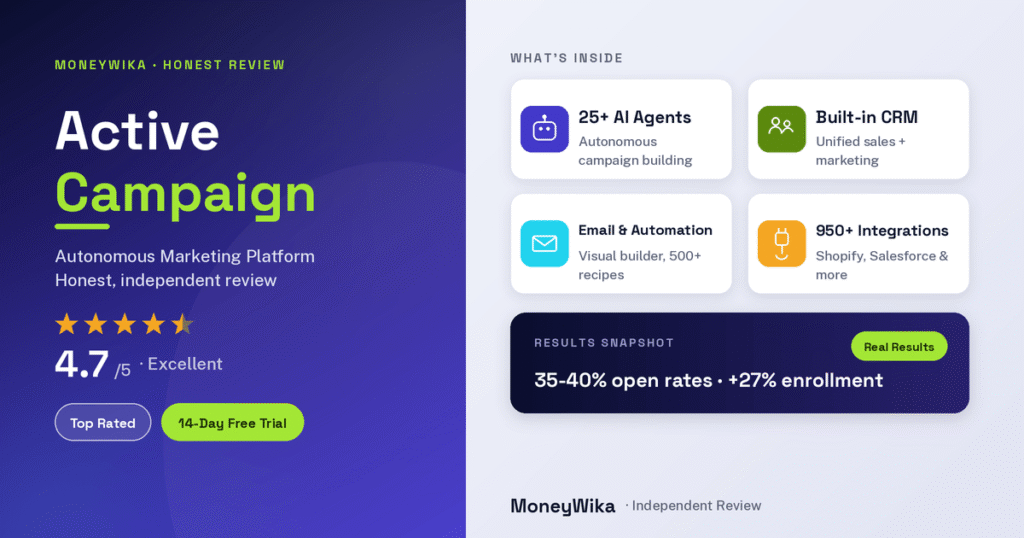
ActiveCampaign was already one of the strongest marketing automation platforms for small and mid-sized businesses, and Active Intelligence 3.0: Wavelength is the reason we've raised our rating to 4.7. An AI that knows your account, prepares drafts, delivers recaps and watches your automations without being asked is the genuinely novel part, the named customer results (Kommunicate, Motrain, INFINITUS) back up the claims better than most vendor stats do, and #1 deliverability plus the Anthropic Claude integration give the AI real substance. The pricing demands some care (Starter won't get you the AI value you're here for, and add-ons stack up), but for ecommerce brands, agencies, and growing teams ready to graduate from basic email into real autonomous marketing, ActiveCampaign is the platform I'd recommend looking at first in 2026.
Try ActiveCampaign Free for 14 Days →