
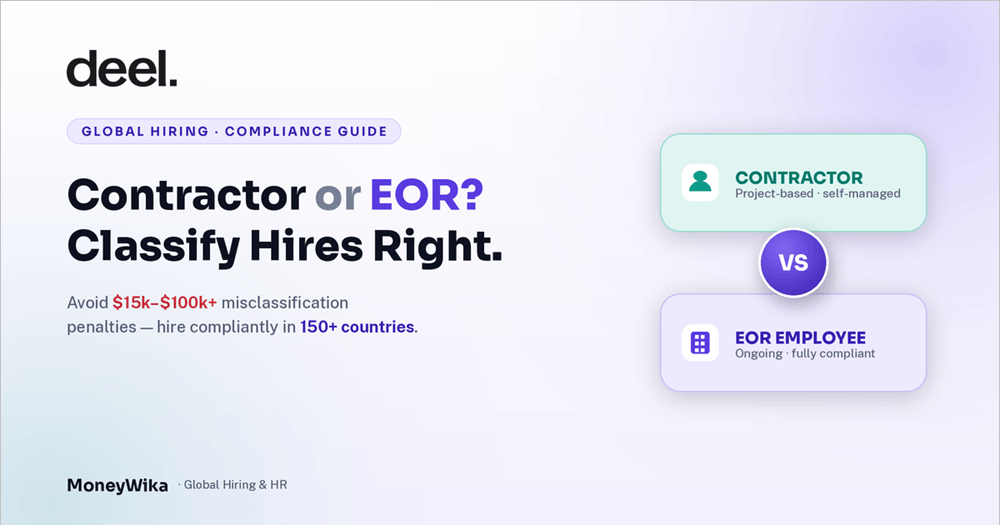
Deel EOR vs. contractor: how to classify global workers correctly, and avoid the misclassification penalties that can cost tens of thousands per person. A plain-English guide to getting it right, and how Deel keeps you compliant, before you hire across borders.
Disclosure: This post contains affiliate links. We may earn a commission at no extra cost to you if you sign up through them.
You have found the perfect hire in another country. Now comes the question that quietly decides whether your expansion is a smooth win or a compliance headache: do you bring them on as an independent contractor, or employ them properly through an Employer of Record?
It sounds like an administrative footnote. It is not. Getting this wrong is one of the most expensive mistakes a growing company can make, and the penalty does not care whether the error was deliberate or an honest oversight. Regulators look at how the working relationship actually functions, not what your contract calls it. Call someone a contractor while treating them like an employee, and you can be liable for back taxes, unpaid benefits, fines, and legal fees that regularly run into five or six figures per person.
The good news: the rules are learnable, and the right structure is usually obvious once you understand what regulators are looking for. This guide breaks down what each model really means, how to decide between them, what misclassification actually costs, and how to stay compliant as you scale globally.
Contractor vs. EOR: What Each One Actually Means
Both let you work with talent in another country without opening a legal entity there. That surface similarity is exactly why they get confused, and why companies pick the wrong one. Underneath, they are built for very different situations.
Independent Contractor
A self-employed professional who provides services under a commercial agreement, not an employment contract. They manage their own taxes, equipment, and benefits, set their own methods, and typically serve multiple clients. You pay their invoices. You do not withhold payroll taxes or provide statutory benefits.
Employer of Record (EOR)
A third party that legally employs the worker in their country on your behalf. The EOR runs local payroll, withholds taxes, provides compliant contracts and statutory benefits, and carries the employer's legal responsibility. You still manage the person's day-to-day work, tasks, hours, and priorities.
Here is the mental model that keeps you out of trouble. A contractor is a vendor you hire to deliver a result. An EOR employee is a member of your team whose employment paperwork is handled by a specialist so you stay compliant without setting up a subsidiary. This is the model platforms like Deel are built around, letting you run both contractor and EOR relationships from one place. The moment a "contractor" starts behaving like a team member, exclusive, integrated, directed day to day, the contractor label stops matching reality, and that mismatch is what regulators punish.
"The contract does not decide classification. The working relationship does. That single fact is behind almost every misclassification case."
Contractor vs. EOR: Side by Side
| Factor | Independent Contractor | EOR Employee |
|---|---|---|
| Legal employer | None (self-employed) | The EOR, on your behalf |
| Best for | Short-term, project, specialist work | Ongoing, core, long-term roles |
| Setup speed | Fast, sign an agreement | Fast, often days, no entity needed |
| Who handles tax | The contractor | The EOR (withholds & remits) |
| Statutory benefits | Not provided by you | Provided & compliant locally |
| Cost | Lower, invoice only | Higher, salary + employer costs + fee |
| Control you can exert | Limited (result, not method) | Full day-to-day direction |
| Misclassification risk | High if used like an employee | Low, EOR carries compliance |
| IP protection | Depends on contract terms | Strong, via employment terms |
Read the last two rows twice. The reason companies move roles onto an EOR is rarely the payroll convenience, it is that the EOR absorbs the classification risk and locks down IP ownership through a proper local employment contract. With a contractor, both of those are on you.
Which One Should You Use?
Forget cost for a second, because the cheaper option is worthless if it triggers a penalty. Start with how the role actually works. The signals below are the same ones regulators weigh, so they double as both a decision guide and a risk check.
✓ A contractor fits when…
- The work is a defined project or deliverable with an end
- They set their own hours, tools, and methods
- They work for other clients, not just you
- They bring specialist skills you need occasionally
- They are genuinely running their own business
▲ You need an EOR when…
- The role is ongoing, core, or open-ended
- You set their hours, priorities, and how they work
- They are exclusive or near-exclusive to you
- You want to offer benefits, equity, or stronger retention
- They are fully integrated into your team and tools
A useful pattern many companies follow: start with a contractor for a short, well-defined engagement, then convert to EOR employment the moment the role becomes ongoing or business-critical. Contractors are a lower-commitment entry point; an EOR is how you keep a good one long-term without misclassifying them. Deel is designed for exactly this transition, converting a contractor to a full EOR employee in the same country without you opening an entity. The mistake is leaving someone on a contractor agreement for two years while treating them exactly like staff, that is the classic setup an audit is built to catch.
Classification tests differ everywhere. Many US states apply the strict "ABC test," the UK has IR35, and much of the EU leans toward presuming employment when control is present. A worker who is safely a contractor in one country can be a misclassified employee in another performing identical work. Cross-border scale multiplies the exposure.
What Misclassification Actually Costs
This is the part that turns an abstract HR decision into a boardroom problem. When a worker is reclassified as an employee after the fact, the bills arrive from several directions at once, and one finding often triggers audits across multiple agencies.
In the United States, the IRS, the Department of Labor, and state agencies can all pursue you separately. Under IRS Section 3509, unintentional misclassification typically means penalties starting around $50 per unfiled W-2, 1.5% to 3% of wages, and 20% to 40% of the unpaid employee FICA taxes, plus the full employer share. If a regulator decides the misclassification was willful, those reductions vanish: you can be liable for 100% of unpaid FICA, face criminal fines of up to $1,000 per worker, and, in the worst cases, personal liability for owners and officers.
State penalties stack on top. In California, for example, willful misclassification can draw civil penalties of $5,000 to $15,000 per violation, rising to $10,000 to $25,000 where regulators find a pattern. Add back wages, unpaid overtime with liquidated damages, and retroactive benefits, and industry guides commonly put total exposure at $15,000 to $100,000 or more per misclassified worker, depending on how long the arrangement ran.
This is not a small-business-only risk. High-profile settlements include roughly $100 million from Uber and $27 million from Lyft to resolve California driver-classification claims, and a $97 million settlement over long-term contractors denied employee benefits.
The lesson is not "avoid contractors." It is "classify honestly, and match the model to the reality of the work."
How Regulators Decide Who Is an Employee
You cannot manage a risk you cannot see, so it helps to know the actual criteria. Two frameworks dominate in the US, and their logic echoes classification tests worldwide.
The IRS three-factor test
The IRS weighs the whole relationship across three lenses: behavioral control (do you direct how, when, and where the work is done?), financial control (who provides tools, who bears profit-and-loss risk, is the worker paid a steady wage or per project?), and the type of relationship (is it ongoing, is the work core to your business, are there benefits?). No single answer decides it; regulators look at the overall picture.
The ABC test
Used by many US states, the ABC test is stricter, it presumes a worker is an employee unless the company can prove all three of these:
Free from control
The worker is free from your control and direction in performing the work, in practice, not just on paper.
Outside your core
The work falls outside the usual course of your business, not the thing your company actually does.
Independent trade
The worker is customarily engaged in an independently established trade, business, or profession.
Notice how easily an everyday arrangement fails part B. If you run a software company and your "contractor" is a full-time developer building your core product, they are doing the usual course of your business, and under the ABC test that alone can make them an employee no matter what the agreement says.
How to Stay Compliant as You Scale
Classification is not a one-time decision you make at signing; it is something to get right up front and revisit as roles evolve. A few habits keep you safe:
Classify honestly
Run each role through the control and integration signals before you sign, not after an audit.
Localize contracts
Use agreements written for each worker's country, generic templates do not survive local law.
Review as roles grow
When a contractor becomes ongoing or exclusive, convert to employment before the risk builds up.
Use a compliant platform
Let an EOR or contractor-management service carry the local compliance so you do not have to.
That last step is where most scaling companies land, because building this expertise in-house for every country is slow and expensive. This is exactly the gap Deel fills: it acts as the EOR in 150+ countries and also manages contractors compliantly, so you can engage a freelancer today and convert them to a full Deel employee later without switching systems or opening an entity. Deel also runs built-in classification checks that flag a contractor arrangement before it becomes the kind of misclassification an audit would catch, which is precisely the risk this guide is about.
Where Deel fits in
One platform for compliant contractors and EOR employees, worldwide
Deel is one of the largest global hiring platforms, built specifically to solve the classification and payroll problem this guide describes. It handles the compliance layer so your team can focus on the work, not the paperwork.
- EOR employment in 150+ countries
- Compliant contractor agreements & payments
- Localized contracts vetted for local law
- Built-in misclassification risk checks
- Convert contractors to employees easily
- Payroll, taxes, and benefits handled
To see how Deel stacks up in practice, our hands-on Deel review walks through the platform, pricing, and real pros and cons, and our Deel vs. Rippling comparison is worth reading if you are weighing the two leading global-hiring options head-to-head.
Classify and hire global workers the compliant way with Deel
Whether you need a contractor for a project or a full employee in a new country, Deel handles the classification, compliance, contracts, payroll, and taxes, in 150+ countries, so you can grow your team with confidence.
Frequently Asked Questions
An independent contractor is a self-employed professional you engage under a commercial agreement. They manage their own taxes, tools, and benefits, and typically work for multiple clients.
An Employer of Record (EOR) is a third party that legally employs a worker in their country on your behalf, running compliant payroll, withholding taxes, and providing statutory benefits, while you still direct their day-to-day work. In short, a contractor is a vendor; an EOR employee is a team member whose employment paperwork is handled for you.
In the United States, penalties come from the IRS, the Department of Labor, and state agencies, often at the same time. Under IRS Section 3509, unintentional misclassification can mean around $50 per unfiled W-2, 1.5% to 3% of wages, and 20% to 40% of unpaid employee FICA taxes plus the employer share.
Willful violations can mean 100% of unpaid FICA, criminal fines up to $1,000 per worker, and personal liability. State fines add more, for example $5,000 to $25,000 per violation in California. Industry guides commonly put total exposure at $15,000 to $100,000 or more per misclassified worker.
They look at how the relationship actually works, not what the contract says. The IRS weighs behavioral control, financial control, and the type of relationship. Many US states use the stricter ABC test, which presumes employment unless the worker is free from control, performs work outside your usual business, and runs their own independent trade.
Other countries have their own tests, such as IR35 in the UK. Across all of them, the common thread is control and integration: the more you direct the work and the more central it is to your business, the more likely the worker is legally an employee.
You can, but only if the role genuinely fits contractor criteria. Contractors are legitimately cheaper and faster for short-term, project-based, or specialist work where the person controls how they deliver.
Using a contractor to save money on what is really a full-time, integrated, ongoing role is the classic misclassification trap, and the penalties usually dwarf the savings. If the role is core and ongoing, employing through an EOR is both safer and, once penalties are factored in, often cheaper overall.
Convert when the engagement stops looking like a project and starts looking like a job. Key triggers include the work becoming ongoing or open-ended, the person working exclusively or near-exclusively for you, you setting their hours and methods, or the role becoming central to your business.
A common and sensible pattern is to start someone as a contractor for a defined initial engagement, then move them onto EOR employment as soon as the relationship becomes long-term. Platforms like Deel let you make that switch without opening a local entity.
The Bottom Line
Classify for reality, not convenience
The choice between a contractor and an EOR is not really about cost, it is about matching the model to how the work actually functions. Use a contractor for genuine project work where the person runs their own show. Use an EOR when the role is ongoing, core, and directed by you. Get that match right and the compliance mostly takes care of itself.
Get it wrong and the arithmetic is brutal: a few thousand dollars "saved" on payroll costs can turn into tens of thousands in back taxes, fines, and legal fees per worker, across multiple agencies and countries at once. As you scale, the practical answer for most companies is to let a compliant platform carry the local employment and classification burden, so you can hire the best person for the job regardless of where they live, without betting the business on a paperwork label. Classify honestly, localize your contracts, revisit as roles grow, and you turn a major risk into a routine, solved problem.
This article is for general informational purposes only and does not constitute legal, tax, or financial advice. Worker-classification rules, tests, and penalties vary significantly by country and by US state, and change over time; the figures cited reflect published third-party sources as of 2026 and are illustrative, not exhaustive. Always consult a qualified legal or tax professional before making classification decisions for your business. This page contains affiliate links, which means we may earn a commission at no extra cost to you if you sign up through them. Our editorial opinions are our own.