
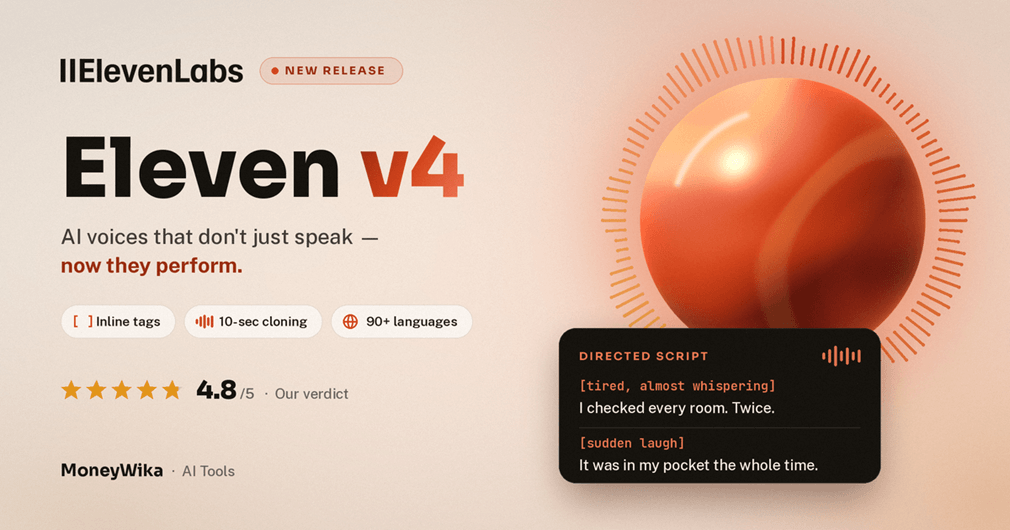
ElevenLabs just released Eleven v4, and it's the biggest change to its voice models since v3. It runs on a completely new text-to-speech architecture. You can direct how each line is delivered, clone a voice from just 10 seconds of audio, and keep a narrator sounding like the same person across a whole audiobook. ElevenLabs says it's ranked #1 by Artificial Analysis. There's also a fast version, Eleven v4 Turbo, built for voice agents. For the next two weeks the launch pricing is unusually generous. Here's what changed, what it costs right now, who should switch, and how to get a good result in your first ten minutes.
Anyone who has made a long voiceover with AI knows the frustrating part. The voice sounds great for one clip. Then on paragraph forty it sounds slightly different, the emotion lands on the wrong word, and you end up regenerating the same line six times hoping it comes out right.
Eleven v4 is aimed squarely at that problem. ElevenLabs describes it as a model for projects where how something is said matters as much as what is said. Earlier models made voices sound real. This one is about making them perform, and keeping that performance consistent from the first line to the last.
If you're new to ElevenLabs, our full ElevenLabs review explains the plans and how credits work. This post focuses on what v4 changes.
What's new in Eleven v4
Six changes stand out. Together they shift ElevenLabs from "very good text-to-speech" towards something closer to directing a voice actor.
A completely new architecture
v4 isn't a tuned-up v3. It's a new text-to-speech architecture built for expressive performance, and ElevenLabs calls it its fastest and most emotive model yet.
Inline tags and unspoken context
Control delivery, emotion, pacing, reactions, sound effects and style right inside your script. Or just describe how a line should be delivered and v4 stages the scene.
Voice cloning from 10 seconds
Instant Voice Clones now capture a voice with high fidelity from just 10 seconds of audio. Professional Voice Clones remain the highest-fidelity option.
A voice that stays the same voice
Speaker identity holds more reliably across long narration, dialogue, and lines you regenerate. That's the fix long-form creators have been waiting for.
90+ languages, noticeably better
Performance improves across 90+ languages, with major gains in Japanese, Brazilian Portuguese, Mandarin and Cantonese.
Eleven v4 Turbo for agents
A low-latency version for real-time uses like voice agents, where a response has to start almost instantly.
Earlier models taught AI voices to sound human. Eleven v4 is about getting them to act.
Directing a voice line by line
This is the change that will save the most time. With older models, if a line came out flat, your only real option was to rewrite the punctuation and regenerate. With v4 you tell the model what you want.
There are two ways to do it. You can place inline tags in your script to control delivery, emotion, pacing, reactions and sound effects. Or you can add unspoken context: a short description of how the line should be performed that isn't read aloud.
These lines are illustrations of the idea, not the official tag list. Check ElevenLabs' v4 documentation for the exact tags and syntax it supports.
In practice this means fewer regenerations. And since regenerating drafts is where most people's credits actually go, it should also mean your monthly allowance stretches further.
When you find a tag or description that gets exactly the delivery you want, write it down with the voice you used. After a few projects you'll have a personal library of directions that work, and you'll stop guessing. We keep ours in RytePad, alongside reminders for when each project's voiceover is due.
Eleven v4 vs v4 Turbo vs v3
Here's how the new models compare with v3, based on what ElevenLabs has announced.
| Eleven v4 | Eleven v4 Turbo | Eleven v3 | |
|---|---|---|---|
| Built for | Expressive, high-quality performance | Low latency, real-time agents | Expressive speech |
| Architecture | Completely new | New, speed-optimised | Previous generation |
| Delivery control | Inline tags plus unspoken context | Inline tags plus unspoken context | Audio tags |
| Instant cloning | High fidelity from 10 seconds | High fidelity from 10 seconds | Needed longer samples |
| Long-form consistency | Improved | Improved | Could drift |
| API launch price | $22 per 1M characters | $11 per 1M characters | Standard rates |
| Best use | Audiobooks, video, dubbing | Voice agents, live apps | Existing projects |
The simple rule: use Eleven v4 when quality and emotion matter most. Use v4 Turbo when speed matters most, such as an agent answering a phone call, where a delay of even half a second feels awkward.
Eleven v4 launch pricing
For two weeks from launch, ElevenLabs is making v4 much cheaper to try.
In ElevenCreative (the app)
Eleven v4 is free for Creator plans and above, up to 2x your monthly credits. If you're on Creator, Pro or higher, you can generate with v4 during the promotion without using up your normal allowance. If you've been thinking about upgrading from Free or Starter, this is the moment to do it.
In ElevenAPI (for developers)
The Eleven v4 API is discounted to $22 per 1 million characters, and v4 Turbo to $11 per 1 million characters. That's a strong rate for testing v4 in a real product before the promotion ends.
The models are available now in ElevenCreative, ElevenAgents and ElevenAPI.
The free usage and API discounts are a two-week launch promotion that started when v4 went live in October 2026. After that, normal plan credits and API rates apply. Check ElevenLabs' pricing page for current figures, and use the promotion to test v4 on a real project rather than a quick demo.
Where Eleven v4 makes the biggest difference
Audiobooks and long narration
The voice now holds its identity across a whole production, not just one clip. For a ten-hour audiobook, that consistency is the difference between usable and unusable.
Character voices and storytelling
Dialogue with real emotional range, reactions and pacing, directed line by line without re-recording or hand-editing the audio.
Video voiceovers
Audio that fits the slot it's made for with no manual retiming, so voiceovers line up with your edit the first time.
Localization and dubbing
90+ languages with stronger results in Japanese, Brazilian Portuguese, Mandarin and Cantonese, so one script can reach a global audience.
Courses and training content
A consistent, warm instructor voice across every module. If you sell courses on a platform like the one in our Teachable review, updating a lesson becomes a script edit, not a re-recording session.
Voice agents
v4 Turbo is built for the low latency that conversational agents need. If you're deploying one on a support line, our Aircall review covers the phone system side, and our Chloe AI agent review looks at how AI agents perform in practice.
How to get a great result in your first 10 minutes
Pick a real script, not a test sentence
Use a paragraph from an actual project with some emotion in it. "The quick brown fox" won't show you what v4 can do.
Generate it plain first
Run it with no tags so you hear the baseline. You may find v4 already gets most of the delivery right on its own.
Direct only the lines that need it
Add a tag or a short description to the two or three lines that came out wrong. Over-tagging every line usually sounds forced.
Test a 10-second clone of your own voice
Record ten clean seconds in a quiet room and try an Instant Voice Clone. Only clone voices you own or have written permission to use.
Try a second language
Run the same script in another language, especially one of the newly improved ones, and check that the voice still sounds like the same person.
If you plan to generate audio regularly through the API, you can connect it to a content pipeline so new scripts are voiced automatically. Our Make.com review shows how that kind of no-code automation is put together.
Should you switch to Eleven v4?
Switch now if…
- You make long-form narration, audiobooks or courses
- You keep regenerating lines to fix emotion or emphasis
- You need a consistent cloned voice across projects
- You publish in Japanese, Portuguese, Mandarin or Cantonese
- You're on Creator or above and can use v4 free during launch
You can wait if…
- You only make short, simple reads where v3 already works
- You have a finished project voiced on v3 that needs to match
- You're mid-production and changing models would break consistency
- Your workflow depends on settings you haven't re-tested on v4
One sensible approach is to finish current projects on the model you started with and start every new project on v4. That avoids a mid-project change in how the voice sounds.
Try Eleven v4 while the launch offer lasts
Free for Creator plans and above in ElevenCreative (up to 2x your monthly credits), with the API discounted to $22 per 1M characters for v4 and $11 for v4 Turbo. Both offers run for two weeks from launch.
Available in ElevenCreative, ElevenAgents and ElevenAPI · 90+ languages · 10-second instant cloning
Frequently asked questions
Eleven v4 is ElevenLabs' newest text-to-speech model, released in October 2026. It's built on an entirely new architecture for expressive performance, and ElevenLabs describes it as its fastest and most emotive voice model yet, ranked #1 by Artificial Analysis.
It adds inline tags and unspoken context for directing delivery, high-fidelity voice cloning from 10 seconds of audio, stronger long-form consistency and improved results across 90+ languages.
Eleven v4 is optimised for quality and emotional range, which suits audiobooks, video, dubbing and storytelling. Eleven v4 Turbo is optimised for low latency, which suits real-time uses like voice agents.
During the launch promotion, the v4 API costs $22 per 1M characters and v4 Turbo costs $11 per 1M characters.
For two weeks from launch, Eleven v4 is free for Creator plans and above in ElevenCreative, up to 2x your monthly credits.
Free and Starter users can still try it, but it uses normal credits. After the promotion, standard plan credits and API rates apply.
Instant Voice Clones in v4 capture a voice with high fidelity from just 10 seconds of audio, including its tone and personality. Professional Voice Clones, which use longer recordings, remain the highest-fidelity option.
Only clone your own voice or a voice you have clear written permission to use.
Eleven v4 supports 90+ languages. ElevenLabs highlights major improvements in Japanese, Brazilian Portuguese, Mandarin and Cantonese.
Eleven v4 and v4 Turbo are available now in ElevenCreative for creators, ElevenAgents for conversational agents, and ElevenAPI for developers building voice into their own products.
The verdict
Eleven v4 goes after the problems that have held AI voiceover back for long projects: voices that drift, emotion that lands in the wrong place, and endless regenerations to fix a single line. Line-level direction, 10-second cloning and better long-form consistency each address one of those directly.
v4 Turbo makes the same leap available for real-time agents, and the stronger results in Japanese, Brazilian Portuguese, Mandarin and Cantonese open up more markets for localized content.
The timing matters too. With v4 free for Creator plans and above, and the API heavily discounted for two weeks, this is the cheapest it will be to test the model on a real project. If how your audio sounds affects what your work is worth, try it now.
Feature details, the Artificial Analysis ranking and launch pricing in this article come from ElevenLabs' Eleven v4 announcement in October 2026. The free ElevenCreative usage for Creator plans and above (up to 2x monthly credits) and the discounted API rates of $22 per 1M characters for Eleven v4 and $11 per 1M characters for Eleven v4 Turbo are a two-week launch promotion. Pricing and availability may change, so confirm current details on the ElevenLabs website. The script examples are illustrations, not ElevenLabs' official tag syntax. This page contains affiliate links, which means we may earn a commission at no extra cost to you if you sign up through them. Our opinions are our own.