
Printify lets you build a real product business, t-shirts, mugs, hoodies, wall art, without ever holding stock, printing an item, or paying upfront.
You design, they print and ship on demand, and you keep the profit. Here is how it works, and whether it is worth it in 2026.
Here is the dream a hundred "start a side hustle" videos sell you: design a cool t-shirt tonight, wake up to sales, never touch a box. The catch is usually the boring middle part, buying stock, printing, packing, shipping, eating the loss on what doesn't sell. Printify's entire reason to exist is to delete that middle part.
Printify is the world's largest print-on-demand (POD) network, and the model is beautifully simple: you create designs, list them in your store, and only when a customer actually buys does a printing partner produce that single item and ship it straight to the buyer, with your branding on the package. No inventory. No upfront cost. No warehouse. You are effectively running a product brand with the risk engineered out of it.
In this in-depth review we will walk through exactly how Printify works, the features that matter, a real seller's example, its 2026 pricing (laid out clearly), the honest trade-offs, and who should, and shouldn't, build on it. Let's start with the part everyone gets stuck on, how the whole thing actually functions.
What Is Printify, Really?
Strip away the marketing and Printify is two things at once.
First, it is a design and mockup tool, a free studio where you upload artwork, drop it onto a blank product, and get photorealistic images to sell with.
Second, and more importantly, it is a marketplace of print factories. Printify itself owns no printers. Instead, it connects you to 100+ vetted print providers around the world and lets you choose which one makes your products, based on price, location, and quality.
That second part is the quiet genius of it. Because providers compete for your orders, you get real choice, on cost, on shipping speed, and on where your product is printed.
Print in the US for US buyers, or in the EU for European ones, and you cut delivery times sharply. And if one provider is slow or slips on quality, you switch to another without redesigning a thing. You are never locked to a single factory's prices or reliability.
"Printify isn't a printer. It's a switchboard connecting your designs to whichever factory in the world makes them best, cheapest, and closest to your customer."
It plugs directly into the places you already sell, or want to: Shopify, Etsy, TikTok Shop, WooCommerce, eBay, Amazon, Wix, Squarespace and more. Connect a store once, and products you design in Printify appear there ready to sell, with orders flowing back automatically.
How Printify Works, Start to Finish
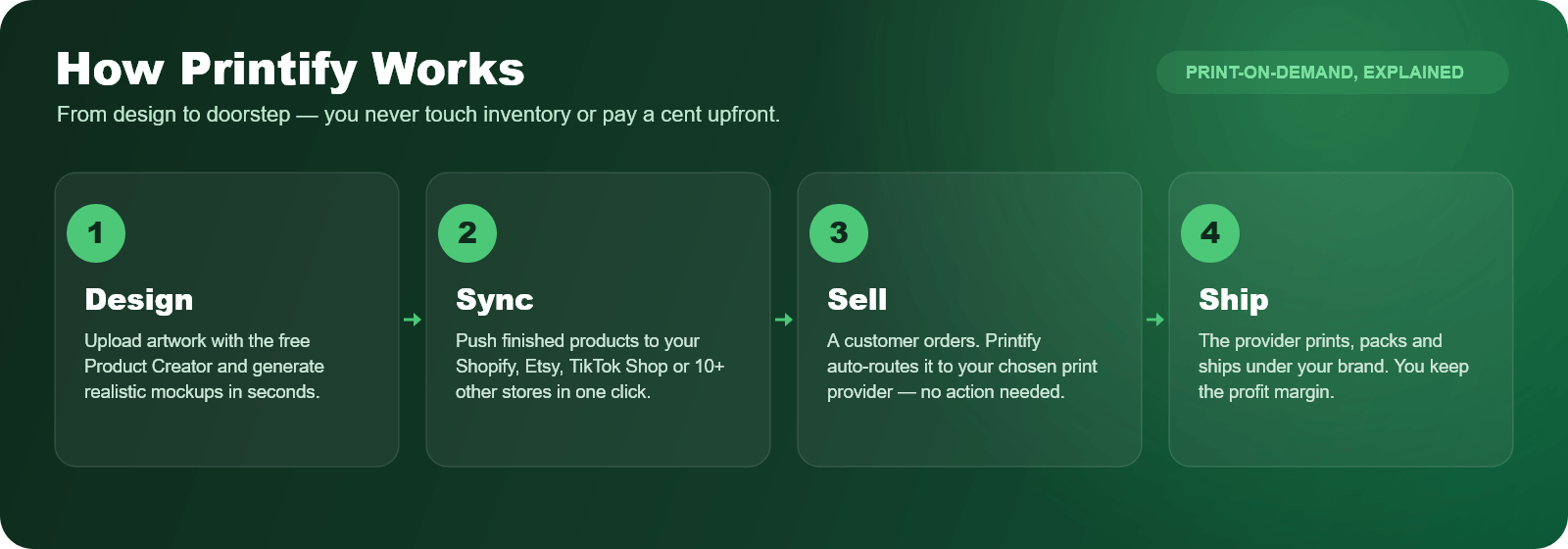
The best way to understand Printify is to follow a single product from idea to delivered parcel. Here is the entire lifecycle, and notice how little of it you actually touch.
One design's journey through Printify
What you do vs. what happens automatically
You pick a product & a provider
Choose a blank from 1,300+ options, a t-shirt, mug, hoodie, tote, poster, then pick which print provider makes it based on price, reviews, and location. This one choice controls your cost and quality.
You upload art & generate mockups
Drop your design into the free Product Creator, position it, and Printify renders professional mockup photos instantly, no photographer or Photoshop needed. Set your retail price and see your profit per sale.
You publish to your store
One click sends the product, images, description, and variants to your connected Shopify, Etsy, or TikTok Shop store. From here on, you mostly do marketing.
A customer buys, the order auto-routes
When someone orders, Printify automatically sends it to your print provider and charges you the base cost. You never manually forward an order.
The provider prints, packs & ships
The factory produces that single item and ships it directly to your customer, optionally with your branding on the packaging. You keep the difference between retail and base cost as profit.
Say a t-shirt's base cost (print + item) is $9 and you sell it for $24. You keep roughly $15 minus your store/transaction fees, and you paid nothing until the sale happened. Scale that across dozens of designs and it becomes a real business, with zero inventory risk.
Key Features That Set Printify Apart
1,300+ product catalog
Apparel, mugs, phone cases, wall art, home goods, accessories, and more, one of the widest POD catalogs anywhere, always expanding.
100+ competing print providers
Choose your factory by price, quality rating, and location. Print near your customers to slash shipping times and costs.
Free Product Creator & AI tools
Design, position artwork, and generate realistic mockups for free, with AI image generation and background tools built in.
Deep store integrations
One-click sync with Shopify, Etsy, TikTok Shop, WooCommerce, eBay, Amazon, Wix, and more, orders flow back automatically.
Branding & custom packaging
Add custom neck labels, packing slips, and inserts so the parcel looks like your brand, not a generic dropshipper.
24/7 merchant support
Round-the-clock chat support plus a large help center and academy, useful when an order or provider needs sorting fast.
A Real Example: Launching a Design Overnight
Meet Sam, a freelance illustrator who has never sold a physical product. He has a following on Instagram and one good joke design for cat owners. Here is how his first Printify product goes live, and it genuinely can happen in an evening.
From sketch to sellable in one evening
No stock bought, no money spent
Connects Etsy, picks a shirt
Sam links his Etsy shop to a free Printify account and picks a well-reviewed provider printing Bella+Canvas tees near his US buyers. Cost so far: $0.
Uploads the design, sees mockups
He drops his cat illustration onto the shirt, nudges the placement, and Printify spits out a dozen photorealistic mockups in different colors. No camera, no models.
Prices it for profit
Base cost is about $10; he lists at $26 and Printify shows him a clean ~$16 margin per sale before Etsy fees. He sets it and publishes.
First sale, hands-off fulfilment
A follower buys one. Printify auto-charges Sam the $10 base, the provider prints and ships it, and Sam keeps the margin, without packing a thing. He orders one sample for himself to check quality.
That sample order is the one step smart sellers never skip, and it points at the single most important rule for POD success: always order a sample of your own product before you promote it. Print quality varies between providers, and holding the real thing tells you more than any mockup.
Printify makes the product; you still need traffic and a place to sell. It pairs naturally with the rest of a creator's toolkit: a link-in-bio storefront like the one in our Beacons.ai review to funnel your audience to your shop, an email platform like the one in our ActiveCampaign review to turn one-time buyers into repeat ones, and automation from our Make.com review to connect your store, email, and spreadsheets.
Printify Pricing in 2026
This is where Printify is genuinely friendly to beginners: you can run a real store on the free plan indefinitely. Paid plans don't unlock the ability to sell, they mainly lower your per-item base cost and add scale features. You pay Printify nothing until a customer buys (then just the base cost of that item).
Annual billing on Premium knocks the effective price down to around $19.99/month. The break-even is easy to reason about: if the ~20% base-cost discount on Premium saves you more than the ~$25 monthly fee, upgrade, otherwise stay free. Most sellers start free and switch once orders are consistent.
Your true expense in POD isn't the subscription, it's the base cost + shipping of each item, which varies a lot by product and provider. Thin margins are the number-one reason POD stores struggle. Before committing to a design, check the base cost across a few providers, add shipping, and make sure your retail price leaves a healthy margin after store fees. Prices change, so always confirm live rates in your Printify dashboard.
Pros & Cons
👍 What we liked
- Genuinely free to start, no inventory or upfront cost
- Huge 1,300+ product catalog, widest in POD
- 100+ competing providers mean choice on price, quality & location
- Excellent, beginner-friendly design & mockup tools
- Deep one-click integrations with all major sales channels
- Custom branding on products & packaging
- Strong reputation: 4.6★ across thousands of reviews
👎 What to watch
- Quality & shipping vary by provider, sampling is essential
- Margins can be thin; base costs add up fast
- You don't control fulfilment or customer-service speed directly
- Best discounts require the paid Premium plan
- Occasional sync or order-error reports with some providers
- It's a crowded market, success still depends on your marketing
Who Should Use Printify?
Choose Printify if…
- You want to start a product business with zero inventory risk
- You're a creator, artist, or influencer with an audience to sell to
- You want the widest catalog and choice of print providers
- You already sell (or plan to) on Etsy, Shopify, or TikTok Shop
- You want to test designs cheaply before scaling winners
Look elsewhere if…
- You need total, hands-on control of printing and fulfilment
- You want the highest possible margins (bulk/in-house wins there)
- You need guaranteed, uniform quality across every order
- You want a single dedicated printer relationship, not a network
- You're not willing to market your store actively
Launch your product line tonight, for free
Printify's free plan lets you design products, generate mockups, and connect your store without spending a cent. You only ever pay when a customer actually buys. There's no lower-risk way to start a product brand.
Frequently Asked Questions
Yes. Printify has a genuinely free forever plan that lets you connect up to five stores, create unlimited product designs, and access the full catalog and mockup tools, with no monthly fee.
You only pay the base cost (printing + the blank item) of a product when a customer actually orders it. The paid Premium plan ($24.99/month, or about $19.99 billed annually) is optional and mainly gives you up to 20% off base costs, so it's worth it once your order volume is high enough for the discount to beat the fee.
Printify earns a margin on the base cost of each product produced through its network, and from Premium and Enterprise subscription fees. Because it aggregates huge order volume across many sellers, it negotiates lower rates with print providers and takes a slice.
That alignment is good for you: Printify only makes money when you make a sale, so its incentive is to help your store succeed.
It can be, but profit depends entirely on your margins and marketing, not on Printify itself. Your profit is your retail price minus the base cost, shipping, and store/transaction fees. A typical t-shirt might cost around $9 to $12 at base and sell for $22 to $28, leaving a healthy margin.
The sellers who make real money treat it like a business: they pick products with room for margin, order samples, and drive traffic through social media, SEO, or ads. Printify removes the inventory risk, but it doesn't do the selling for you.
They take different approaches. Printify is a network of 100+ independent print providers, which gives you more product choice, more locations, and generally lower base prices, but quality can vary between providers, so sampling matters.
Printful owns its own facilities, giving more consistent, controlled quality and branding, but usually at higher prices and with a smaller catalog. If price and choice matter most, Printify tends to win; if uniform quality control is your priority, Printful is worth the premium. Many sellers use both.
Printify connects with all the major e-commerce platforms and marketplaces, including Shopify, Etsy, TikTok Shop, WooCommerce, eBay, Amazon, Wix, and Squarespace, among others. It also offers an API for custom setups.
Once connected, products you create in Printify publish to your store in one click, and incoming orders are sent to your print provider automatically, so you don't manually process fulfilment.
Not unless you tell them. Printify ships orders as a white-label service, meaning parcels go out under your brand, not Printify's. On supported products you can add custom branding like neck labels, packing slips, and inserts to make the unboxing feel like your own brand.
This is a big advantage over some dropshipping models, your customers experience your store, not a visible third-party fulfiller.
The Verdict
Printify has earned its spot at the top of print-on-demand. A genuinely free plan, the widest product catalog in the industry, a network of 100+ competing providers, and slick, beginner-friendly design tools add up to the lowest-risk way to turn a design idea into a real, shippable product.
For creators, artists, and anyone wanting to test a product business without gambling on inventory, it is close to a no-brainer.
The honest caveats are inherent to the model, not flaws in Printify. Because it relies on third-party factories, quality and shipping vary by provider, so ordering samples is non-negotiable. Margins need real attention too, since base costs add up, and success still comes down to your designs and your marketing.
But as the engine that handles everything physical, Printify is excellent, and starting tonight for free removes the last excuse not to try. Design something, order a sample, and let your first sale make the case.